
PIGMENTATION · 6 MIN READ
Acne in Skin of Colour: Why It Presents Differently and What Helps
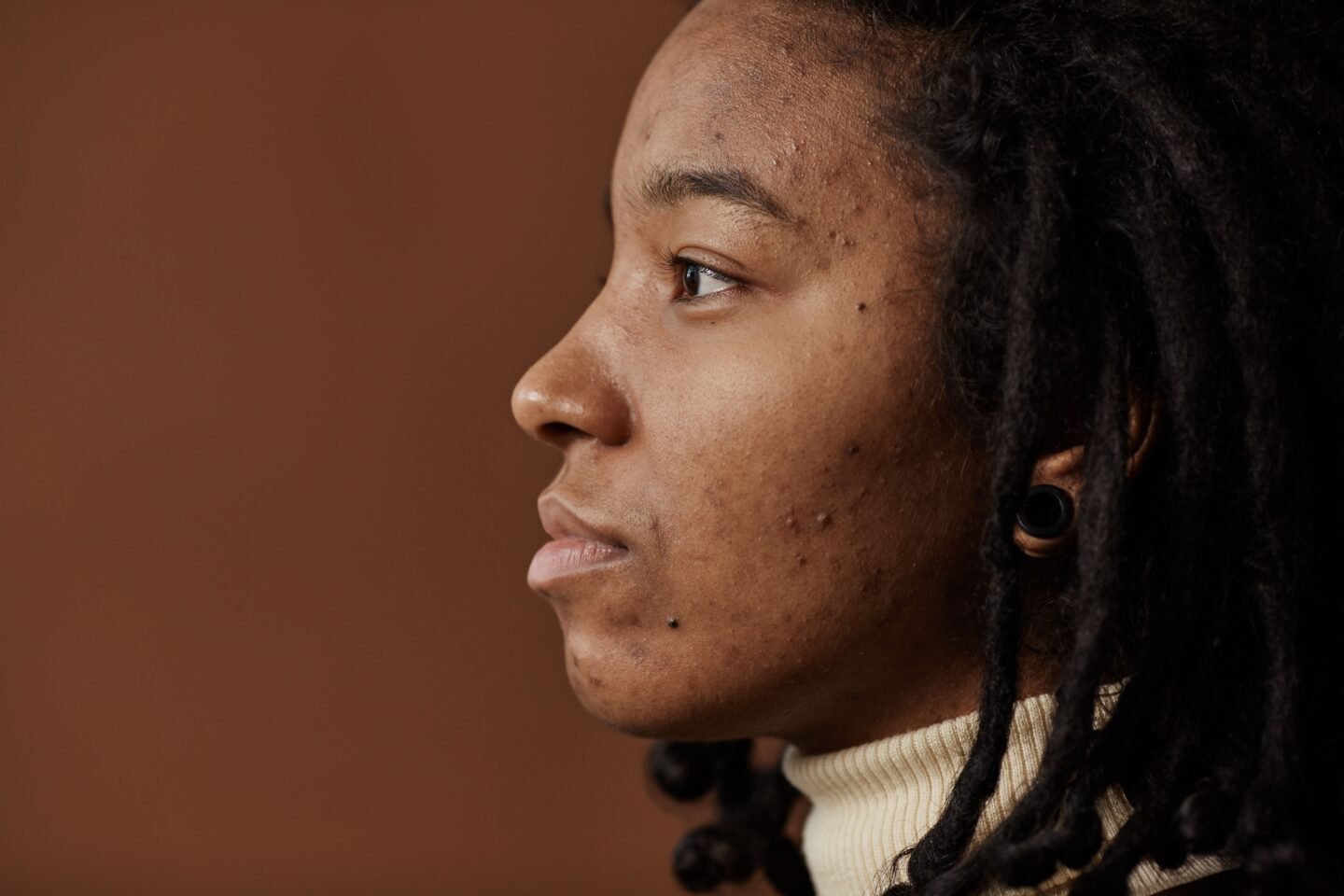
If you have brown or black skin, you may have noticed that the spot is rarely the real problem; the dark mark it leaves behind is. Acne on skin of colour behaves differently than on lighter skin, and the biggest difference is what happens after a breakout clears. This article explains why that is, what the evidence says about treating it safely on melanin-rich skin, and how to break the cycle of spots and dark marks without making things worse.
The dark mark is the main event
On lighter skin, a healing spot usually fades to pink and disappears. On melanin-rich skin, the same spot often leaves a flat brown, grey, or black mark; also called post-inflammatory hyperpigmentation (PIH), the extra pigment the skin produces in response to inflammation. For most people with skin of colour, these marks are the reason they seek help, and they routinely outlast the acne itself by months.
This isn’t a minor cosmetic footnote. In a landmark study of acne in skin of colour, post-inflammatory hyperpigmentation was one of the most common and most distressing features patients reported, frequently more troubling to them than the active spots.¹ A later review confirmed that PIH is a defining feature of acne in darker skin and a primary driver of how it should be treated.²
The practical takeaway: on skin of colour, every breakout is also a potential dark mark. That single fact should shape every decision you make about your skin.
Why acne behaves and looks differently on darker skin
Three things set acne in skin of colour apart:
Inflammation runs deeper than it looks. On darker skin, the redness of an inflamed spot reads as violet, brown, or simply “darker” rather than bright pink, so acne can look milder than it is, and is sometimes under-treated as a result. Research has shown meaningful inflammation even in seemingly mild, comedonal (blackhead and whitehead) acne in skin of colour.²
The marks last far longer. Melanin-producing cells in skin of colour are more reactive, so inflammation triggers more pigment, deposited more deeply, and cleared more slowly. A mark that would fade in weeks on lighter skin can take six to twelve months or longer on darker skin.
Scarring risk is higher. Skin of colour is more prone to raised (keloid and hypertrophic) scars, so picking or squeezing carries a greater cost here than on lighter skin.
Because the dark mark is downstream of the inflammation, the single most effective thing you can do for dark marks is to treat the acne early and calmly with a dual-focus approach. Manage both active breakouts and dark marks at the same time, and, crucially, avoid treatments that cause fresh irritation, because irritation is just more inflammation, and more inflammation means more pigment.
What actually happens and what the evidence says
There’s no overnight fix, and anything promising one isn’t being honest with you. What works is a short list of evidence-supported ingredients, used gently and consistently. It’s worth being candid about the evidence base itself: a 2022 systematic review found that while the common acne treatments all reduce lesions and are generally well tolerated in skin of colour, relatively few trials have focused specifically on darker skin, so some guidance is extrapolated from studies in lighter skin.³ That’s a reason for a careful, individualised approach, not a reason to do nothing.
Acne develops through four linked steps, and the most useful ingredients each target one or more of them. This is also why azelaic acid is such a favourite for skin of colour: it works at every step, and the final step, inflammation, is the one that drives the dark marks.
| Step | What’s happening in the skin | Ingredients that target it |
|---|---|---|
| 1. Excess oil | Hormones prompt the glands to overproduce sebum (oil) | Retinoids, niacinamide, azelaic acid, salicylic acid |
| 2. Blocked pore | Dead skin cells fail to shed and plug the follicle | Retinoids (e.g. adapalene), salicylic acid, mandelic/glycolic acid, azelaic acid |
| 3. Bacteria | C. acnes multiplies inside the blocked follicle | Benzoyl peroxide, azelaic acid |
4. Inflammation | The immune response causes redness and swelling and, on skin of colour, the dark marks | Niacinamide, azelaic acid, benzoyl peroxide, salicylic acid |
Melanin-producing cells in skin of colour are more reactive. When a spot becomes inflamed, the skin responds by making extra pigment, called post-inflammatory hyperpigmentation, which is deposited more deeply and clears more slowly than on lighter skin. The mark is a response to inflammation, which is why calming acne early is the best way to prevent it.
Yes, used carefully. Benzoyl peroxide works well against acne, but it can irritate the skin, and on skin of colour, irritation can trigger dark marks. Use lower strengths (around 2.5–5%) or a short-contact wash-off routine rather than high-strength leave-on products, and pair it with a good moisturiser.
By treating the acne first, then fade the dark marks with gentle, evidence-supported ingredients like azelaic acid, niacinamide, and a carefully introduced retinoid, alongside daily iron-oxide-tinted sun protection. Deeper or stubborn marks can benefit from professional treatment such as gentle peels, chosen with skin of colour in mind.
It can. Inflammation that appears bright red on lighter skin often looks violet, brown, or simply darker on skin of colour, so acne can seem milder than it is. The most visible sign is frequently the dark mark left behind rather than the spot itself.
Azelaic acid is particularly well suited to skin of colour because it does two jobs at once: it calms acne and interrupts excess pigment production, and it’s generally well tolerated.² For many people with brown and black skin, it’s one of the most useful single ingredients available.
Niacinamide calms inflammation, regulates oil production and reduces the transfer of pigment to skin cells; a well-known study found it meaningfully reduced pigmentation when applied topically.⁴ It’s gentle enough to pair with almost anything.
Benzoyl peroxide is effective against acne bacteria, but it’s a common cause of irritation, and on skin of colour, irritation means marks. Use lower strengths (around 2.5–5%), or as a short-contact “wash off after a few minutes” treatment, rather than high-strength leave-on products.²
Gentle chemical peels (salicylic or mandelic acid) performed at the right strength can help both acne and pigmentation, and feature among the treatments reviewed as effective and tolerable in skin of colour.³ On darker skin, the skill of the practitioner matters more than the strength of the peel.
Daily sun protection ties it all together. Light, including the visible light that passes straight through ordinary sunscreen, deepens existing marks, so a broad-spectrum sunscreen tinted with iron oxides protects your progress. Without it, dark marks fade far more slowly.
What to be cautious of
Resist the urge to pick or squeeze it’s the fastest route to a longer-lasting mark or a permanent scar.
Be wary of harsh scrubs and stacking strong actives, which cause the very inflammation you’re trying to avoid.
Steer well clear of unregulated “skin-lightening” or “bleaching” creams bought informally or from abroad: some contain high-strength hydroquinone, potent steroids, or mercury, and can cause lasting harm, including a stubborn, paradoxical darkening.
The honest timeline
Clearing the spots is the faster part; fading the marks is the slower one. Expect active acne to improve over a few weeks to a couple of months with a consistent routine, and the dark marks to take several months beyond that. The people who get the best results aren’t using the strongest products; they’re being the most consistent and the most gentle. Patience genuinely is part of the treatment.
If your acne is painful, cystic, scarring, or simply not responding, it’s worth getting a personalised assessment rather than persevering alone. Early, tailored treatment is what prevents both scarring and marks.
Not sure where to start with your own skin? Our free skin consultation asks about your skin, your concerns, and your history, and gives you tailored recommendations in minutes, built for skin of colour from the start.
Book your free skin consultation → HERE
Frequently asked questions

References
- Taylor SC, Cook-Bolden F, Rahman Z, Strachan D. Acne vulgaris in skin of color. J Am Acad Dermatol. 2002;46(2 Suppl):S98–106.
- Davis EC, Callender VD. A review of acne in ethnic skin: pathogenesis, clinical manifestations, and management strategies. J Clin Aesthet Dermatol. 2010;3(4):24–38.
- Pathmarajah P, Peterknecht E, Cheung K, et al. Acne vulgaris in skin of color: a systematic review of the effectiveness and tolerability of current treatments. J Clin Aesthet Dermatol. 2022;15(11):43–68.
- Hakozaki T, Minwalla L, Zhuang J, et al. The effect of niacinamide on reducing cutaneous pigmentation and suppression of melanosome transfer. Br J Dermatol. 2002;147(1):20–31.